Do I need a licence to rent a boat in Croatia?
+
For a bareboat charter you need a recognised skipper's licence plus a separate VHF radio operator's certificate. Croatia accepts the ICC, RYA Day Skipper, ASA 104, the German SBF-See and SKS, and most national EU coastal licences. Small motorboats below the local engine limit need no licence, and the base confirms the exact figure when you book. Without a licence, add a skipper and the requirement moves to them. Bring the original document, not a photo: larger marinas ask to see it at check-in.
When is the best time to rent a boat in Croatia?
+
The season runs April to October, with July and August the warmest and busiest. May, June and September give you reliable weather, warm water and quieter bays, which is why most repeat charterers pick them. On price, May is the real saving: a 40 foot sailboat averages €1,680 that month against €2,670 in July. September is lovely but costs almost the same as peak. April and October are cheapest of all, with cooler water and a higher chance of bura.
How much does it cost to rent a boat in Croatia for a week?
+
A 40 foot bareboat sailboat, the most common Croatia charter, averages €1,680 a week in May and €2,600 to €2,900 in July and August. Add the charter package, marina berths and fuel and a July week lands around €3,150 to €3,900 all in, before food and drink. Catamarans run €3,500 to €9,000, motor yachts start near €2,800, and crewed gulets sleeping up to 12 start at €8,000. Your first and last night in the home marina are included.
What is the difference between bareboat, skippered and crewed charters in Croatia?
+
Bareboat is the cheapest: you skipper it yourself and you need your own licence and VHF certificate. Skippered adds a professional Croatian captain for €170 to €220 a day, no licence needed from you, and they bring local knowledge of the anchorages and the wind. Crewed adds a hostess and, on bigger boats, a cook, which is the standard set-up on gulets and large catamarans. Skippered is the most popular choice for a first Croatian charter.
Which Croatian islands are best for first-time sailors?
+
The central Dalmatian coast around Zadar, Šibenik and Biograd, plus the Kornati archipelago, suits first-timers best. Hops between islands are often under 10 nautical miles, the water is sheltered from open-sea swell and the holding is reliable. The Split, Brač and Hvar triangle works well too, with marinas at Trogir, Milna and Palmižana. Leave the exposed Kvarner Bay for a later trip, and the longer southern runs from Dubrovnik for a second or third charter.
Can I rent a boat one-way from Split to Dubrovnik?
+
Yes, and it is the classic Croatian route. Most large fleets offer it for a one-way fee of €250 to €600 depending on boat size, operator and season. The passage covers about 130 nautical miles past Hvar, Korčula, Mljet and the Elaphiti islands before Dubrovnik's Gruž marina. Book six to nine months ahead, since one-way slots are limited. The reverse direction usually costs 10 to 20 percent less, because the summer maestral favours the run south.
What extra costs should I expect on top of a Croatia boat charter price?
+
Budget roughly €600 to €1,500 for a week. The charter package is the main one, €100 to €400 by boat size, covering end cleaning, bed linen, towels, the boat permit and tourist tax, paid at the base on check-in. Marina berths beyond your included first and last night run €70 to €190 a night in July and August. Fuel is about €150 a week under sail, more if you motor. A refundable deposit is blocked separately.
How far in advance should I book a boat rental in Croatia?
+
For July and August, six to twelve months. For May, June, September and October, three to five months is usually enough. The most-wanted boats, newer catamarans and the well-kept sailboats out of Split and Dubrovnik, are often gone by January. Earlybird discounts of up to 20 percent apply if you book before the end of February. Last-minute deals surface within four weeks of departure, but the choice is thin and one-way routes almost never appear.
What are the Kornati and Mljet National Park fees for a Croatia boat charter?
+
Kornati charges by boat length. An 11 to 18 metre boat pays €95 a day in June to September if you buy online before you arrive, and €190 if you buy inside the park. Off-season it is €50 and €95. Mljet charges €25 per person a day in June to September and €15 the rest of the year, including one return boat trip to St Mary's Island. Buy both online. Anchoring is restricted in the parks, so use the numbered mooring buoys.
How much does a skipper cost when renting a boat in Croatia?
+
A professional skipper costs €170 to €220 a day, or €1,200 to €1,550 for a Saturday-to-Saturday week, paid locally. You also feed them and give up a cabin. In return you need no licence yourself, and you get someone who knows which bay to take when the bura is forecast. It is the most popular option for a first Croatian charter. Browse the skippered fleet on our
Croatia yacht charter with skipper page.
Can I rent a boat in Croatia for 3 days or a weekend?
+
Yes. Motorboats, RIBs and speedboats rent by the day all season. Many sailing yachts and catamarans take 3-day or weekend bookings in April to June and September to October. In July and August most sailing yachts run Saturday to Saturday, so short charters are much easier to find early or late in the season. A 3-day rental is priced per night, so it costs well under a full week.
Is a catamaran or a monohull better for a Croatia boat charter?
+
A catamaran gives you more deck and cabin space, shallower draft for tucking into bays, and almost no heel, which suits families and mixed-experience crews. A monohull costs less to charter, less to berth, and sails better upwind in the afternoon maestral. Marinas also charge catamarans more for the wider berth, and peak-season catamaran berths are harder to book. For a first Croatian week with non-sailors aboard, most crews are happier on a catamaran.
What is the security deposit on a Croatia boat charter and when do I get it back?
+
The deposit is blocked on the skipper's credit card at check-in, not charged, and released after a clean check-out. On a 40 foot monohull it is usually €1,500 to €3,000, rising to about €5,000 on a large catamaran. Release typically takes a few working days once the base confirms the boat came back as it left. Most operators also sell a damage waiver for €100 to €350 if you would rather not have the sum blocked.
Which airport should I fly into for a Croatia boat charter?
+
Split (SPU) serves the biggest cluster of bases: Trogir is about 10 minutes away and Split about 25. Zadar (ZAD) covers the Zadar and Biograd bases and the Kornati. Pula (PUY) serves the Istrian bases and sits about 15 minutes from the Pula marinas. Dubrovnik (DBV) serves the southern bases and one-way finishes. Šibenik has no airport of its own, so fly into Split or Zadar. Saturday transfers are busy in July and August, so land in the morning, or the night before.
What happens if the weather is bad during my Croatia boat charter?
+
You change the plan, which is normal here. The wind that does it is the bura: it drops off the mountains in hard gusts, and in the Kvarner channels it can exceed 40 knots with little warning. Fleets expect it. Your skipper, or the base if you are bareboat, will tell you which bay to sit in. Build a spare day into the route so one lost afternoon does not put your flight home at risk.
Do I have to be back in the marina on the last night of a Croatia charter?
+
Yes, on almost every Croatian fleet. A Saturday-to-Saturday charter means you are back in the home marina by Friday evening and sleep aboard there, then step off on Saturday morning. Both those nights' berths are already in your charter price. Plan the last day as a short hop rather than a long passage, and count on six full sailing days rather than seven when you build the route.
Can I bareboat charter a 45 foot catamaran in Croatia with an ICC?
+
Sometimes, but check the tonnage first. Croatia's Boat Leader's Licence B covers boats up to 30 GT and a 45 foot catamaran sits right on that line, so on the bigger cats you may need a Yachtmaster level licence rather than an ICC or RYA Day Skipper. Some operators also ask for a second qualified sailor aboard on large catamarans, which is fleet policy rather than Croatian law. If in doubt, book the same boat with a skipper instead.
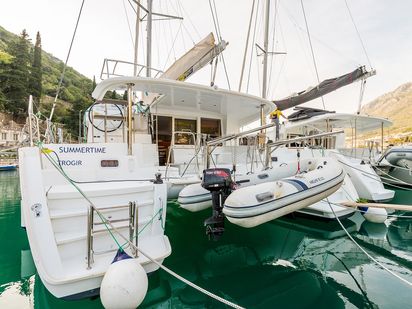
 ACI Marina Trogir, Trogir, Croatia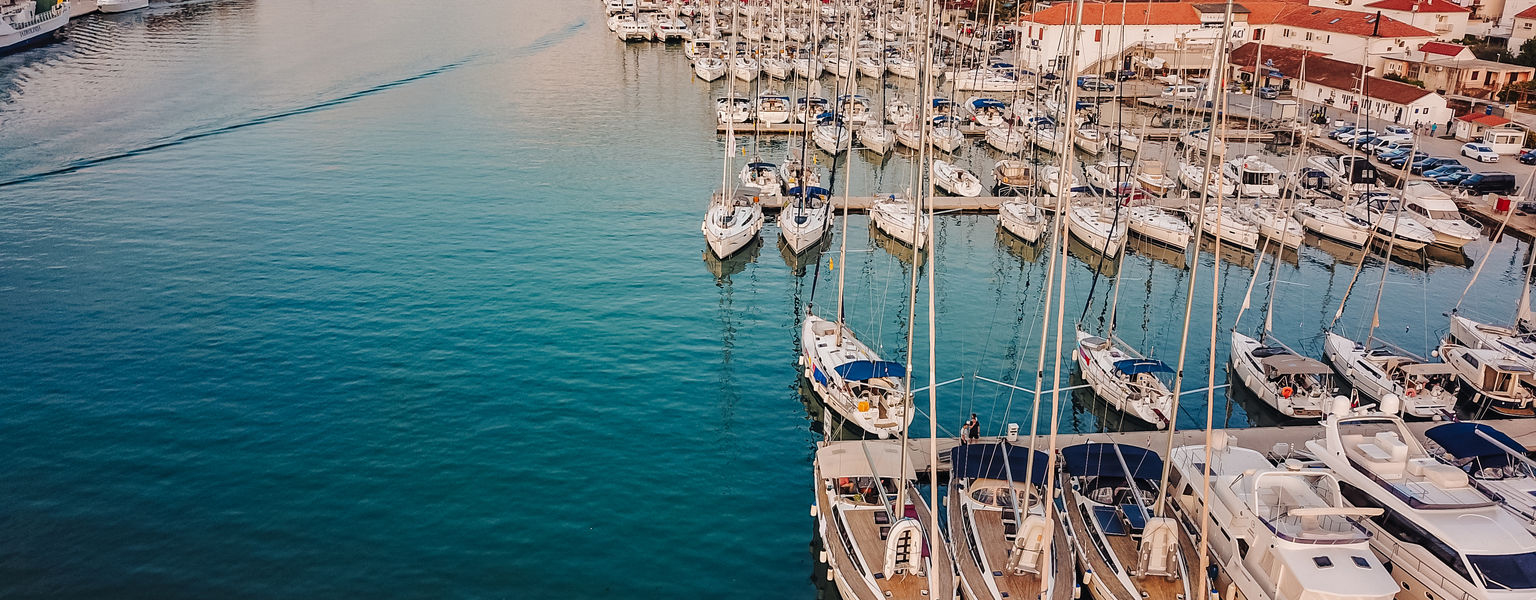

 Earn award miles on every booking.