
When you’re setting sail — whether on a bareboat charter, your own new vessel, or as an experienced offshore skipper — the best marine VHF radios aren’t just a nice-to-have. They’re essential safety tools.
VHF (Very High Frequency) radios are the most important communication devices onboard. You’ll use one to call harbors and marinas, monitor weather updates, check in with your crew, and most critically, issue a distress call if something goes wrong. Unlike cell phones, VHF radios are built for marine conditions — offering waterproof casings, reliable range, GPS integration, and emergency features that can literally save your life.
In this post, we’re diving deep into the best marine VHF radios for 2025 — both handheld and fixed mount — with practical insights into which makes sense for your sailing style. Whether you’re prepping for a coastal weekend or a bluewater passage, we’ll break down the must-have features, real-world favorites, and smart extras that can keep you connected at sea.
Table of Contents
What to Know Before Buying a Marine VHF Radio
Before browsing marine VHF radio reviews, it’s worth understanding what makes a unit not just good — but reliable when it counts.
DSC (Digital Selective Calling)
Digital Selective Calling is now standard on quality radios and essential for modern marine safety. When connected to your GPS and properly registered with an MMSI (Maritime Mobile Service Identity), a single press of the DSC distress button sends out a digital mayday with your vessel’s identity and location to rescue authorities and other boats.
Translation: If your voice can’t get through, DSC can.
Fixed Mount vs. Handheld VHF Radios
Fixed mount VHF radios offer more range and power (up to 25W), making them ideal for offshore sailing or serious cruising. They’re usually installed near the helm or nav station and wired into the boat’s power and GPS systems.
Handheld VHF radios are portable, battery-powered, and great for day trips, dinghy comms, or as an emergency backup. Modern handhelds can float, strobe in water, and integrate GPS as well.
Pro tip: Carry both. Fixed mount for range and reliability, handheld for flexibility and redundancy.
Waterproofing, Battery, and Durability
It’s not enough to just trust box specs. Look for IP67 or IPX8 waterproof ratings, check user feedback on battery life, and seek models with proven ruggedness. Radios are often dropped, sprayed, or used in storms — gear that fails under pressure is a liability.
GPS Integration
Especially valuable for solo sailors or those navigating unfamiliar waters, GPS-enabled VHFs can automatically transmit your coordinates with a DSC call. Even better? Some show your position right on the display.
Tri-Watch and Emergency Features
Tri-watch allows you to monitor channel 16 (emergency), a hailing channel, and a crew channel simultaneously — a feature that’s invaluable in busy cruising areas. Add an emergency strobe that activates if dropped overboard, and you’ve got a radio that truly has your back.
Use Cases – Not All Radios Suit All Trips
The best VHF radio for boats depends on where and how you’re sailing. Different scenarios call for different setups.
Handheld VHF Radios
Ideal for:
- Coastal day sails and inland waters
- Dinghy excursions or paddleboarding away from the mothership
- As a backup to your fixed radio on longer passages
- Charter trips when you’re unsure of the onboard setup
A solid handheld VHF marine radio should float, have a strong battery, GPS, and a rugged shell. Don’t skimp — your backup should be just as dependable as your main unit.
Fixed Mount VHF Radios
These are the gold standard for:
- Offshore cruising
- Overnight passages
- Bluewater charters
- Heavier displacement boats with dedicated nav stations
A fixed mount VHF marine radio with GPS connected is a game-changer. Higher power equals better range, especially when paired with a well-installed antenna. Add AIS (Automatic Identification System) to track nearby vessels and you’ve got a communication powerhouse.
Borrow A Boat Tip: Even if you’re chartering, always ask what model is onboard, when it was last tested, and whether it’s wired to GPS. Bring your own handheld as backup, just in case.
Minimum requirement? IP67 float rating and a good antenna setup.
Best Marine VHF Radios of 2025 – Trusted by Skippers
Here are five top-rated models earning trust from charterers and private owners alike. We’ve combed through marine VHF radio reviews, user forums, and skipper feedback to spotlight what actually works on the water.
1. Standard Horizon HX890
Type: Handheld
Why it’s a favorite:
The Standard Horizon HX890 leads the pack for good reason. This floatable handheld includes GPS, DSC, tri-watch, a strobe light, and even a built-in FM broadcast receiver. It’s got a bright display, programmable memory channels, and comes with a charging cradle.
With rave reviews across sailing forums and gear roundups, the Standard Horizon HX890 review consensus is clear: this is the go-to handheld for serious sailors.
Best for: Skippers who want a rugged, reliable backup with advanced features. Great on charters or as a primary unit for coastal trips.

2. Garmin VHF 215 AIS
Type: Fixed mount
Why it’s a favorite:
If safety and integration are top priorities, the Garmin VHF 215 AIS is a standout. You get 25W of transmitting power, full DSC functionality, NMEA 2000 connectivity for seamless chartplotter linking, and an AIS receiver to see nearby vessels.
Best for: Offshore passages, coastal cruisers, and anyone who wants VHF and AIS in one compact unit.

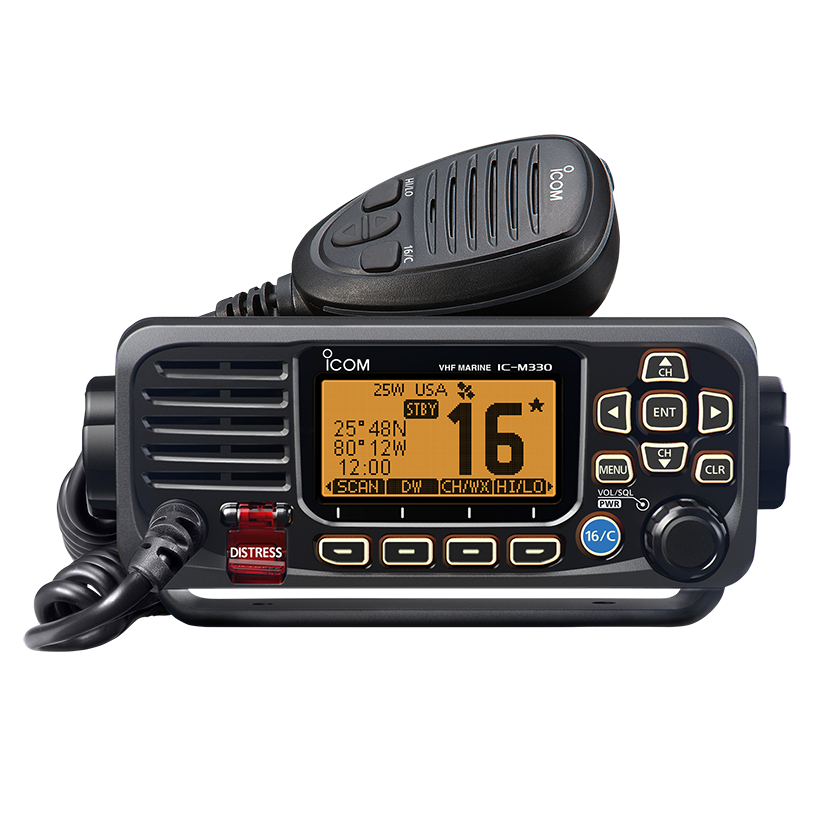
3. Icom M330
Type: Fixed mount
Why it’s a favorite:
Compact, budget-friendly, and exceptionally durable, the Icom M330 is a workhorse on many bareboats and private vessels. It offers clear audio, intuitive controls, and reliable DSC operation, even without bells and whistles.
Best for: Dayboats, budget-conscious cruisers, and skippers who want proven performance in a compact package.
4. Cobra MR HH600
Type: Handheld
Why it’s a favorite:
Bluetooth connectivity, GPS, DSC, and a rugged floating design make the Cobra MR HH600 an excellent all-around handheld. It’s especially good for weekend sailors or as a secondary radio when chartering.
Best for: Inland sailors, weekend charters, or tech-savvy crews looking for Bluetooth features.

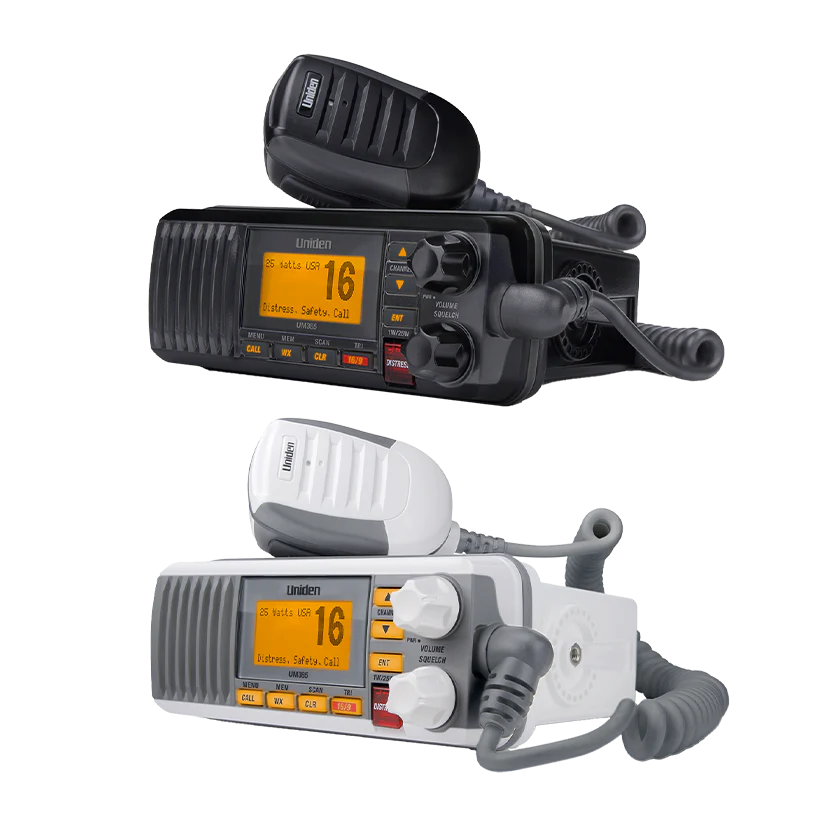
5. Uniden UM385
Type: Fixed mount
Why it’s a favorite:
At under $150, the Uniden UM385 punches well above its weight. While it lacks GPS, it still offers full DSC, 25W output, weather alerts, and a large screen. This is a favorite among budget-conscious coastal cruisers.
Best for: Entry-level skippers or those outfitting a secondary station.
How to Set Up and Use Your VHF Correctly
Even the best VHF radio is only effective if it’s properly set up and used. Here’s what matters:
- Register your MMSI number (required for DSC) and program it into the radio.
- Do a radio check — and repeat it regularly. Not just once a season.
- Channel 16 is for hailing and emergencies only. Use it to initiate contact, then switch to a working channel.
- Use proper radio etiquette. Keep calls short, skip the chit-chat, and avoid music or cursing. It’s not a walkie-talkie.
Don’t use VHF for:
- Calling the marina for dinner reservations
- Chatting about weather for fun
- Playing tunes or testing your vocal cords
Do use VHF for:
- Emergency signals (man overboard, fire, flooding)
- Making contact with the Coast Guard or nearby vessels
- Reporting navigational hazards or urgent traffic info
VHF vs Satellite Communication – When One Isn’t Enough
While VHF is your primary marine communication tool, it has limits — typically 5 to 25 nautical miles depending on antenna height, obstacles, and weather.
When to consider satellite backup:
- Offshore or trans-oceanic passages
- Remote cruising areas with no Coast Guard or harbor traffic
- Chartering in zones without cell service or AIS coverage
Satellite messengers like Garmin inReach or Iridium GO! offer text updates and emergency pings far beyond VHF marine radio range.
What To Add (Without Overcomplicating Your Setup)
You don’t need a NASA-grade nav station. Just a smart setup.
Consider these additions:
- Satellite messengers (Garmin inReach, Zoleo) for emergency backup
- Cell boosters or marine Wi-Fi routers for checking in ashore
- PLBs or EPIRBs for true offshore sailing — your SOS beacon if all else fails
- VHF antennas with proper height and cable run for max range
Keep it simple: Primary + backup = safe, smart, and streamlined.
Why a Personal Handheld VHF Is Worth Packing
Here’s why every sailor should carry their own handheld VHF:
- If the fixed radio fails, you’ve got a lifeline
- For dinghy trips or excursions ashore, it’s ideal for check-ins
- If power drops, a handheld battery can be a game-changer
- Peace of mind on long charters, especially if the onboard radio is outdated or unfamiliar
For under $200, you get redundancy, safety, and versatility. That’s hard to argue with.
Safety Doesn’t Happen by Accident
Whether you’re crossing the Channel, anchoring off Corsica, or enjoying a long weekend in the Solent, having one of the best marine VHF radios aboard isn’t just a smart move — it’s a safety essential.
From the Standard Horizon HX890 to the Garmin VHF 215, these radios are trusted by skippers for a reason. Choose the one that suits your trip, your boat, and your confidence level — then bring it aboard and know it’s got your back.
Ready to set sail? Make sure your gear’s dialed in and book your next yacht charter with Borrow A Boat — because peace of mind starts with preparation.